📘  Taylor & Francis · 2026 · English

AI AND
RISK ANALYSIS
IN PROJECTS

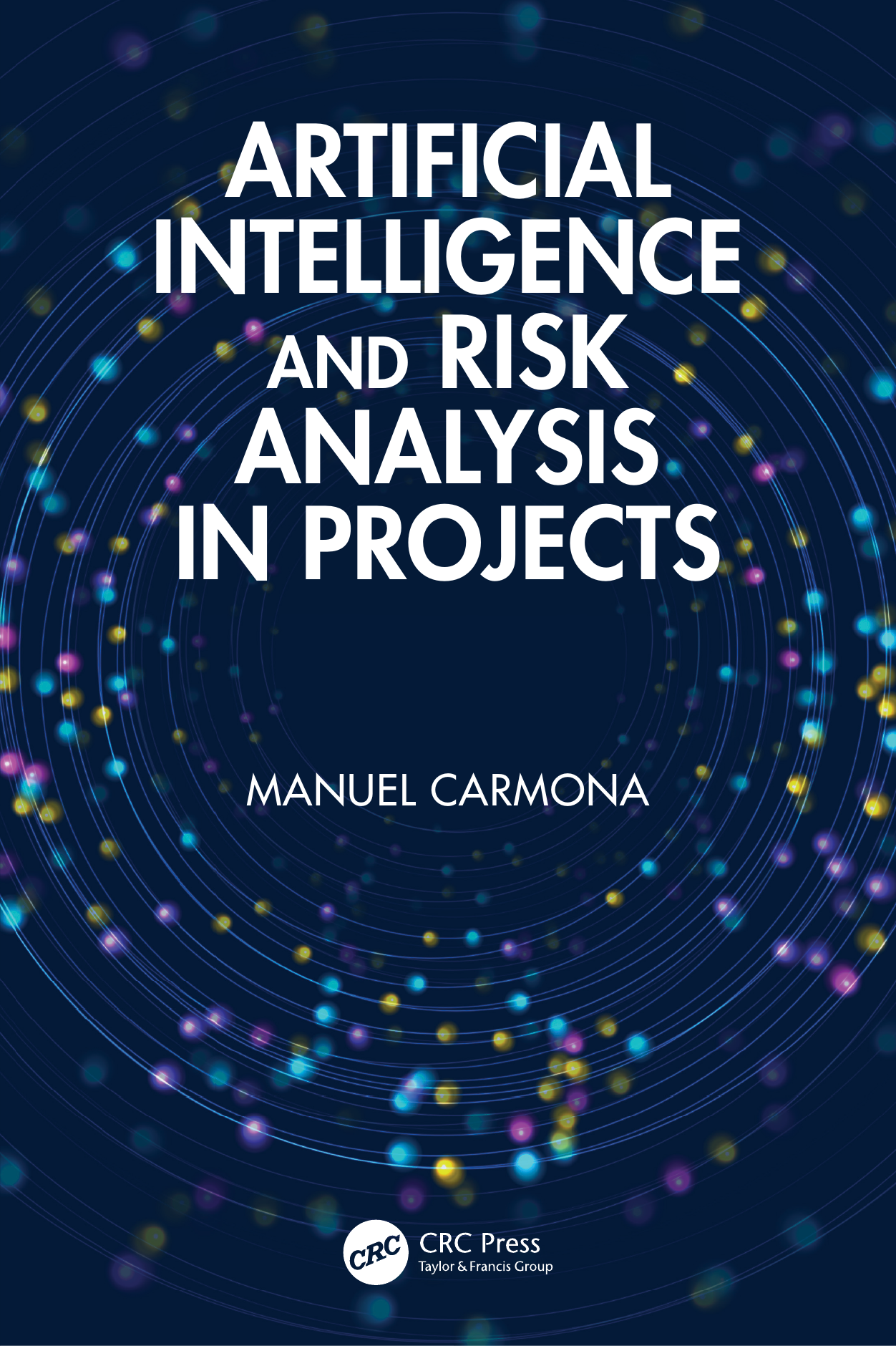
The first practitioner-focused book to integrate probabilistic risk analysis, Monte Carlo simulation, and the practical use of AI language models into a single coherent framework — written for the professionals who actually build and govern project risk models.

🏛️
Publisher
Taylor & Francis · USA
📅
Publication
2026
🌍
Language
English
📖
Chapters
12 chapters
Taylor & Francis · 2026
AI AND
RISK ANALYSIS
IN PROJECTS
Manuel Carmona
MBA · PMI-RMP®
Taylor & Francis
Cover image coming soon
About the book

Written for the
practitioner who
builds the models

Project risk management has a problem that no framework has solved: the gap between what the standards say and what professionals actually do when uncertainty is real, data is imperfect, and decisions cannot wait.

This book closes that gap. It is written for project managers, risk analysts, cost estimators, and PMO leaders who work with uncertainty every day — not for researchers seeking to describe it. Every chapter moves from concept to application, from theory to working model, from analytical output to boardroom-ready communication.

At its core, the book argues that probabilistic thinking is not a specialist skill. It is a professional discipline that every project practitioner can and must develop — and that AI, used correctly, makes that discipline more accessible, more rigorous, and more useful than ever before.

Drawing on over 25 years of consulting and training experience across energy, construction, utilities, and technology sectors, the author presents a framework in which best practice processes, Monte Carlo simulation, decision analysis, and AI language models are not separate tools but parts of a single integrated system for managing uncertainty in projects.
🏛️
Publisher
Taylor & Francis
Leading academic & professional publisher · USA
📅
Publication year
2026
Exact release date to be confirmed
📖
Structure
12 chapters · 3 parts
Foundations · Quantitative Methods · AI Integration
🛒
Where to buy
Amazon & Taylor & Francis website
Purchase links available on release
🎓
Aligned with
Best practice professional standards
No prior quantitative experience required
Who should read this
Project managers
Risk analysts
Cost estimators
PMO leaders
Planners & schedulers
CFOs & investors
Consultants
MBA students
Inside the book

12 chapters.
3 parts.
One framework.

The book is structured in three progressive parts: building the conceptual and process foundations; developing quantitative modelling capability; and integrating AI into every stage of the risk workflow. Each chapter ends with a summary, key takeaways, and practical exercises.

Part I — Foundations
01
Part I
The Landscape of Project Risk: Uncertainty, Complexity, and the Limits of Intuition
Why projects continue to overrun despite decades of progress in methodologies and tools. This chapter establishes the core argument of the book: that the challenge is not a lack of standards but a failure to treat uncertainty as structured, actionable information. It introduces the probabilistic mindset as the essential shift from which all other improvements follow.
02
Part I
The Risk Management Framework: From Plan to Monitor
A rigorous walkthrough of the PMI-RMP® aligned risk management process — Plan, Identify, Analyse, Plan Responses, Monitor — reframed as a decision-support discipline rather than a compliance exercise. The chapter clarifies the critical distinctions between risks, assumptions, constraints, issues, and noise, and explains why getting these right is the foundation of everything that follows.
03
Part I
Building Risk Registers That Work: Structure, Quality, and Cognitive Bias
Most risk registers fail not because the risks are wrong but because the statements are imprecise, the scoring is uncalibrated, and cognitive bias is baked into every assessment. This chapter introduces the Cause–Risk–Effect structure, the Risk Breakdown Structure, and a systematic approach to identifying and correcting the biases — anchoring, availability, optimism — that distort qualitative risk analysis in practice.
04
Part I
From Deterministic to Probabilistic: Why Single-Point Estimates Always Lie
A direct, evidence-based case for abandoning point estimates as the primary currency of project planning. The chapter explains how single-point thinking systematically underestimates cost and schedule exposure, introduces the concept of the planning fallacy, and lays the conceptual groundwork for simulation-based approaches by showing how uncertainty compounds across a project system in ways that intuition cannot track.
Part II — Quantitative Methods
05
Part II
Probability Distributions: Choosing the Right Shape for Each Uncertainty
A practical, decision-focused guide to the distributions used most frequently in project risk modelling — triangular, PERT, normal, lognormal, uniform, discrete, and more. For each distribution, the chapter explains the underlying logic, the type of uncertainty it represents, the data or expert inputs required, and the practical consequences of choosing the wrong shape. Worked examples show how distribution choice changes model output — sometimes dramatically.
06
Part II
Monte Carlo Simulation: Building Models That Reveal What Plans Conceal
The technical and practical heart of the book. This chapter walks through the full Monte Carlo process — from model structure and variable definition through random sampling, iteration, convergence, and output interpretation. Correlations, dependencies, and tail risk behaviour are explained clearly. Step-by-step worked examples build a complete cost risk model in Excel, with every design decision made transparent and justified.
07
Part II
Schedule Risk Analysis and Integrated Cost-Schedule Models
Cost overruns and schedule delays are not independent — yet most organisations model them separately. This chapter develops integrated cost-schedule risk models that capture the interaction between time and cost exposure, explains how to identify and model schedule risk drivers, and demonstrates why the P80 completion date is almost always later — and the P80 cost higher — than teams expect from looking at point-estimate plans.
08
Part II
Decision Analysis: Trees, EMV, and Choosing Between Uncertain Futures
When a project faces a genuine strategic choice under uncertainty — proceed or pause, bid or pass, transfer or retain — decision tree analysis provides a disciplined framework for reasoning through the options. This chapter covers Expected Monetary Value, multi-branch decision trees, sensitivity to probability and consequence assumptions, and the integration of decision analysis with Monte Carlo outputs to support risk response selection and investment staging decisions.
Part III — AI Integration
09
Part III
AI as a Trusted Advisor: How to Work with Language Models Without Being Misled by Them
The foundational chapter for Part III. It establishes the correct mental model for working with AI in a professional risk context — not as an oracle or a replacement for judgment, but as a structured thinking partner that accelerates analytical work when used with discipline. Covers prompt design, validation protocols, known failure modes, and the governance questions that determine whether AI adds value or introduces new risk into the modelling process.
10
Part III
AI-Assisted Risk Identification, Register Management, and Qualitative Assessment
Practical applications of AI across the qualitative risk management process — from scanning project documentation to identify candidate risks, to structuring and improving risk statements, to cross-checking probability and impact assessments for cognitive bias. Includes a library of validated prompts for each task, case examples showing AI output before and after structured human review, and guidance on where AI adds most value and where it consistently falls short.
11
Part III
AI in Quantitative Modelling: Assumption Review, Validation, and Narrative Generation
How AI integrates into the Monte Carlo and decision analysis workflow — reviewing distribution assumptions, flagging logical inconsistencies, stress-testing model structure, and generating the executive narratives that translate probabilistic outputs into decisions. Addresses the black-box problem directly: what happens when AI recommendation and human judgment diverge, and how to maintain accountability and traceability in AI-assisted quantitative analysis.
12
Part III
The Restacked Profession: Agency, Governance, and the Future of Project Risk Management
The closing chapter looks beyond current tools to the structural changes AI is driving in the project risk profession. Drawing on research into human-AI collaboration, cognitive task redistribution, and the evolving nature of professional authority, it argues that the organisations and individuals who will lead in this transition are not those who adopt AI fastest, but those who redesign their processes, governance structures, and professional identity most deliberately — keeping human agency where it is irreplaceable, and expanding machine agency where it is genuinely superior.
También disponible en español

The Spanish edition
is already published

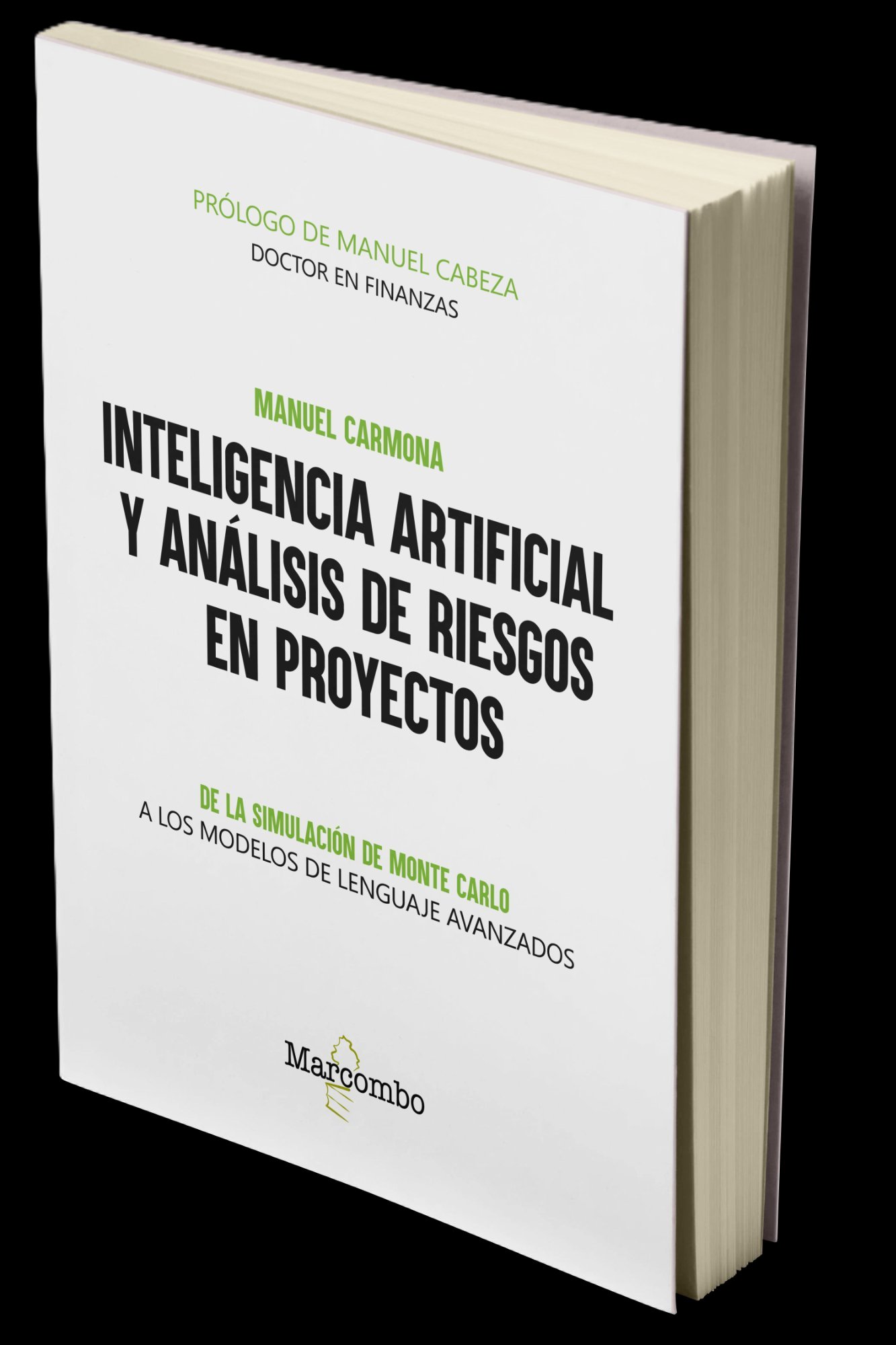
While the English edition is in preparation with Taylor & Francis, the Spanish edition — Inteligencia Artificial y Análisis de Riesgos en Proyectos — is already published and available to purchase. It covers the same rigorous framework of probabilistic risk analysis and AI integration, written for Spanish-speaking project and risk management professionals.

Published by Marcombo — one of Spain's leading technical and scientific publishers — the book has been adopted by universities and professional training programmes across Spain and Latin America.

296
Pages
€26.50
Print
€19.95
eBook
Inteligencia Artificial y Análisis de Riesgos en Proyectos — Manuel Carmona
About the author
Manuel Carmona
PMI-RMP Authorised Instructor PMI AI Expert

Manuel
Carmona

Manuel Carmona is a specialist in quantitative risk analysis, decision modelling, and the integration of AI into project risk management. Over a career spanning more than 25 years, he has advised and trained organisations across energy, construction, utilities, financial services, and technology sectors in Europe, the Middle East, and Asia-Pacific.

He spent a significant part of his career as EMEA Consulting Manager at Palisade — the company behind the @RISK and Palisade risk analysis software suite — delivering risk modelling, training, and implementation projects for some of the world's largest engineering and energy organisations.

Through EdytrAIning, his independent practice, he trains professionals in quantitative risk methods and consults on risk model design, Monte Carlo implementation, and AI-integrated risk workflows. He holds an MBA from the University of Westminster, is a PMI-RMP® Authorised Instructor, and holds the AI Expert Certificate. He is fluent in English, Spanish, and French.

This book is the culmination of two decades of practical experience — an attempt to give project professionals the integrated framework that the literature has not yet provided.

25+ years in quantitative risk
PMI-RMP® Authorised Instructor
AI Expert Certificate
MBA · University of Westminster
Former Palisade EMEA Consulting Manager
Fluent: English · Spanish · French

BE FIRST TO
KNOW WHEN
IT SHIPS

Leave your email and we will notify you the moment the English edition is available to order on Amazon and the Taylor & Francis website. No spam — one email when the book is ready.